
What is HiPot testing?
There are a lot of jargon words in the Test & Measurement (T&M) world, so let’s eliminate some.
HiPot is the abbreviation for ‘High Potential’ and, in turn, ‘Potential’ is short for ‘Potential Difference’ or ‘PD’, which is another term for voltage level. Put them together and you have ‘high voltage level’.
So, HiPot testing just means High-Voltage Testing. Generally abbreviated to HiPot or hi-pot.
What is considered ‘high voltage’?
In safety systems, a high voltage is generally anything above 48V above the system ground. At 50V, from a low impedance source, it is possible to seriously injure a person, and it is necessary to start taking precautions against electrical shock.
Fast, flexible and powerful HiPot testing for cables
The CableEye® HVX Systems combine our M3z technology with a high voltage module to provide HiPot testing of insulation resistance and dielectric breakdown up to 2100Vdc and 1200Vac. Adjustable in 1-volt increments from 10V to 2100V, you have complete control over Ramp-Up, Ramp-Down, Dwell Time (same as Test Time), Trip Current, and Trip Delay (same as Soak Time). This means that you can design each HiPot test procedure to match your customer’s HiPot test standard. Aside from the unique hardware design, the PC based software in all CableEye systems is key to the stability and ease of measurement that has made the whole range of testers such a success.Safety using CableEye HVX Systems
Many safety protections have been built into the system, including a fast-trip 1.5mA current limit, a manual high voltage ‘Enable’ function at startup, and login control to ensure that every user has been properly trained before their login name will enable the system for Hi-Pot testing. Additionally, the optional HV Remote option (item 829X) can link into fixture covers or even area-access control guards and visual/audible warnings through Light Trees and sounders.

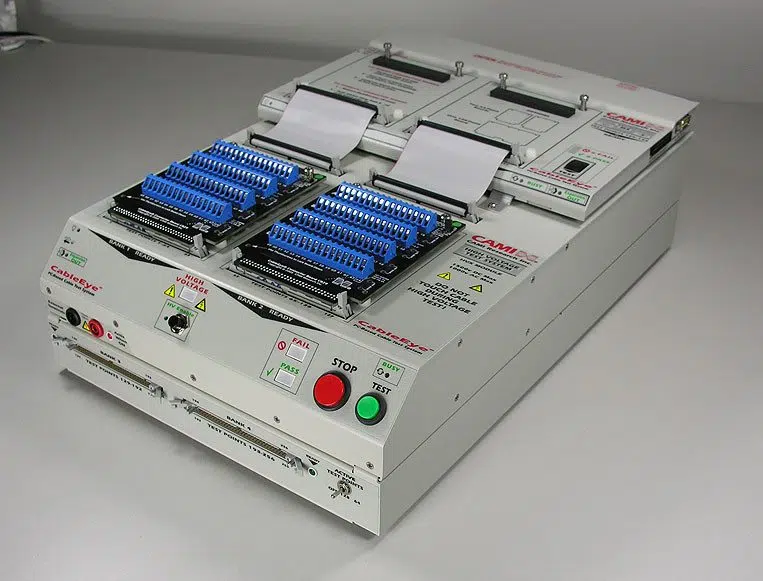

The HVX systems will operate as the M3Z does now for low voltage testing, and then optionally perform HiPot testing up to the voltage limit required.
Another popular option for the CableEye HVX high voltage tester is 4-wire measurement. A module that enables you to eliminate the effect of adaptors and adaptor wiring to show you the actual resistance of your cable-under-test. For more on this take a look at our 4-wire measurement page.
The test results page provides a suite of HiPot test results including leakage current, voltage achieved and insulation breakdown. This means that with the click of a button, you can provide your customer with full testing history and traceability. See our page about the reporting capabilities of CableEye testers, here: https://cimbian.co.uk/products/cami-research/cableeye-reporting/
Integrating HiPot into a Lean Production Flow
High-Voltage Testing in a Lean Environment
In a modern Lean facility, High-Voltage (HiPot) testing is often viewed as a bottleneck due to safety requirements and longer dwell times. However, by applying Jidoka (Autonomation) principles, the CableEye HVX series transforms this “Safety Gate” into an efficient, value-adding stage.
The Strategy: The ‘Clean Gate’ Approach. We recommend a distributed testing model. By using our Low-Voltage (LV) testers at every assembly bench, you catch 100% of conventional wiring errors (shorts, opens, miswires) at the source, whilst keeping the investment at realistic levels. This ensures that your HiPot station is never used for basic fault-finding. Instead, it acts as a dedicated Validation Gate, testing only “Known-Good” cables for dielectric integrity.
Lean Benefits of the CableEye HVX series:
-
Zero Setup Waste: SMED (Single Minute Exchange of Die). Digital test profiles allow one-click changeovers between different cable types and voltage requirements and can be reduced even further to ‘no-click’ changeovers if barcodes are used!
-
Automated Jidoka Safety: Integrated hardware interlocks and fast-trip 1.5mA limits mean the system governs safety, allowing standard operators to manage the flow without constant engineering supervision.
-
Eliminating the Paperwork Loop (MUDA): Results are logged instantly to your central database, providing a digital “birth certificate” for every cable and removing the waste of manual data entry.
Expert Insights: When to use HiPot
In a Lean environment, the M-Series is your “Workhorse” for the assembly line, while the HVX-Series is your “Guardian” for compliance.
Technical Selection: M-Series vs. HVX-Series
| Feature | M-Series (Low Voltage) | HVX-Series (HiPot/HV) |
| Primary Purpose | High-speed assembly verification. | Safety-critical dielectric testing. |
| Test Voltage | 10V DC Max. | Up to 2100V DC / 1500V AC. |
| Continuity Range | 0.1Ω to 10 MΩ | 0.1Ω to 1 GΩ (Insulation Resistance). |
| Core Detection | Shorts, Opens, and Miswires. | Dielectric Breakdown & Arc Detection. |
| Lean Placement | Point of Manufacture: Every bench. | Quality Gate: Final inspection cell. |
| Safety Required | None (Touch-safe). | Hardware Interlocks & Barriers. |
| Compliance | Basic connectivity standards. | Medical (60601), Aerospace, EV. |
High-Voltage Lean: Safety as a Standardised Process
In cable assembly, HiPot (High Potential) testing is often viewed as a “final hurdle”—a dangerous and time-consuming necessity. In a Lean environment, however, safety and efficiency are not at odds. High-Voltage Lean is about removing the “Waste of Fear” and the “Waste of Waiting” by integrating safety directly into the workflow, whilst still verifying the Insulation Resistance and Dielectric Withstand to your customer’s standards.
When HiPot testing is manual or disconnected from the assembly process, it becomes a major bottleneck. By applying Lean principles to high-voltage verification, you transform a high-risk task into a repeatable, high-speed standard.
1. Eliminating the “Waste of Waiting” (Batch Safety)
Traditionally, cables are moved to a specialised “High-Voltage Cage” for testing at the end of a shift. This creates a massive WIP (Work-in-Progress) pile and associated costs.
- The CableEye Solution: Our systems are designed with high-speed switching and safety interlocks that allow for rapid testing. By standardising the safety environment (using interlocked fixtures or light curtains), you can move from batch testing to Continuous Flow, verifying the insulation integrity of each cable as it is finished.
2. Poka-Yoke for Life-Critical Testing
Manual HiPot testing is high-stress. If an operator misinterprets a leakage current reading, a defective (and potentially lethal) cable could ship to a client.
- The Lean Gap: High reliance on human judgment in safety-critical tasks.
- The CableEye Solution: Automated test profiles ensure that the Voltage Ramp, Dwell Time, and Leakage Thresholds are fixed and tamper-proof. The operator doesn’t need to “read” the results; the system provides a binary Pass/Fail based on the exact specifications in the digital drawing.
3. Reducing “Over-Processing” through Logged Compliance
In sectors like Medical or Aerospace, the “Waste of Over-processing” often comes from the administrative burden of documenting HiPot results.
- The Lean Gap: Hand-writing test voltages and leakage results for every cable.
- The CableEye Solution: Every HiPot test is automatically logged with a timestamp and specific test parameters. This provides an instant audit trail for QC, removing the need for manual data entry and ensuring 100% compliance with BS EN 60601 or IPC-WHMA-A-620 standards.
4. Jidoka: Decentralising High-Voltage Expertise
Traditionally, HiPot testing is a “High-Skill” bottleneck. Because of the inherent risks, a senior engineer is often required to oversee the bench, creating a “Waste of Human Potential” as they oversee repetitive safety parameters.
-
The Lean Gap: High dependency on specialist staff for a routine safety task.
-
The CableEye Solution: By integrating hardware and software interlocks as standard, we apply the principle of Jidoka. The system is “intelligent” enough to govern its own safety—it physically cannot fire the high voltage unless the safety circuit is closed.
-
The Result: This “Autonomation” significantly reduces the skill level required for safe operation. You can empower assembly-level staff to conduct 100% HiPot verification without compromising safety or requiring constant engineering supervision, dramatically reducing the Total Cost of Ownership (TCO) for your test process.


Expert Insights: Understanding HiPot Standards & Safety.
-
What is HiPot testing? Essentially, HiPot is short for “High Potential” (High Voltage). It is a stress test of the cable’s insulation to ensure it can withstand voltages far beyond its operating environment without breakdown.
-
What is considered ‘High Voltage’ in cable testing? While international safety standards define High Voltage at significantly higher levels, in the specialised field of cable assembly, the term ‘HiPot’ is often used to describe the transition from basic continuity checks to Insulation Resistance (IR) and Dielectric Withstand (DW) testing.
In practice, professional insulation resistance testing is conducted at voltages of 20Vdc and above. The CableEye HVX series transitions seamlessly from Low-Voltage testing into HiPot, easily handling the requirements of both IR and DW validation within a single automated sequence. -
What should I be testing for? HiPot testing should focus on the value-added assembly steps—cutting, stripping, and crimping—rather than the raw cable specification. You are looking for minute insulation compromises or ‘whiskers’ introduced during manufacture that could lead to field failure.
-
Can HiPot testing be automated? Yes. The CableEye HVX systems automate the entire ramp, dwell, and discharge cycle. This ensures repeatability that manual “probe and buzz” testing simply cannot match.
If you found this page interesting please share it with your friends and colleagues.